

20 Years of ISO 27001
When we began teaching information security in Uruguay in 2004, very few in the region knew what BS 7799 was—the British standard that laid the foundations for modern information security management. Today, two decades later, we support organizations in certification processes across different countries. Datasec’s history with these standards, however, goes back even further. Since 1987—long before the concept of cybersecurity existed as we understand it today—we have been working in IT governance, assurance, and risk management. That trajectory naturally led us to become one of the first organizations in the region to adopt and promote BS 7799 as a management model. In 2004, we began delivering courses at UNIT—the national standards body of Uruguay—based directly on BS 7799-2, at a time when references such as UNE 71502 were also emerging in Spain. ISO/IEC 27001 did not yet exist. There was no ecosystem, no specialized consultants, and no consolidated business demand. That same year, we launched our first implementation project based on BS 7799-2. It was an experience that combined rigor with an inevitable degree of adaptation: limited local references, documentation mostly in English, and organizations that still associated information security with point solutions such as antivirus or firewalls. In that context, building a common language—defining what an ISMS was, why risk management was critical, and how to structure a treatment plan—was an essential part of the work. ——————————————————— OCTOBER 2005 ISO publishes the first edition of ISO/IEC 27001. What we had been teaching and implementing as BS 7799 was consolidated as an international standard. It was not a surprise—it was the logical direction of a process we had been closely following. ——————————————————— That same year, we participated in the creation of UNIT’s specialized technical committee on information security, alongside government bodies, the banking sector, academia, and the technology industry. This process directly contributed to Uruguay adopting ISO/IEC 27001 and ISO/IEC 27002 as national technical standards in 2006, positioning the country among the first in the Americas to formally adopt these standards. THE PATH TRAVELED Since the publication of ISO/IEC 27001, we have supported its evolution through its different versions (2005, 2013, and 2022), in parallel with the maturation of the market. Each update brought specific challenges for organizations. In 2013, the introduction of the High-Level Structure required adapting existing models. In 2022, the reorganization of controls led to new interpretations. This is compounded by the need to manage transition processes in real-world contexts, with time and budget constraints. In this journey, practical experience is critical. That is why Datasec is also an ISO/IEC 27001-certified organization—recertified by LSQA. We understand that it is not possible to properly support a process that has not been experienced from within. The accumulated results of these years are reflected in certified organizations across the Americas, including Uruguay, Argentina, Brazil, Chile, Bolivia, Peru, Colombia, Panama, Costa Rica, Mexico, and Puerto Rico, as well as the United States. In several of these countries, we supported the first ISO/IEC 27001 certifications in their history. In Uruguay, when the country reached its first 21 certifications, Datasec had participated in 16 of them. Beyond the certifications obtained, the main value of this journey has been the transformation that takes place within organizations when information security is properly managed. When top management understands its role in risk management, the conversation shifts away from technical issues and toward strategic decisions, operational continuity, and trust. That transition is, ultimately, the true outcome of the work. “Being pioneers was not a goal. It was the result of having believed—before it was evident—that managing information security rigorously is a competitive advantage, not a compliance cost.” A NECESSARY CLARIFICATION Today, a concept is often repeated as if it were new: that information security is not a technical issue, but a strategic business concern. However, this is not a new idea. This approach was already clearly defined in the mid-1990s. COBIT, published by ISACA in 1996, established that information technology should be governed by organizational leadership, not managed exclusively by technical areas. Within this framework, information security was not an IT department issue, but a business responsibility, with direct impact on strategic objectives, operational continuity, and stakeholder trust. At the same time, BS 7799 was based on the same principle. An information security management system is defined by top management, which sets the context, approves the policy, allocates resources, and accepts residual risk. That is governance. This is not a recent concept. It is a foundation. What has changed is the context in which this principle is applied. The exposure surface is significantly larger, the speed of incidents is higher, and organizations’ digital dependency is much deeper. The distance between a poor decision and an operational crisis is increasingly short. This does not redefine the concept, but it does increase its urgency. Confusing urgency with novelty means overlooking decades of solid conceptual development on which it is now possible—and necessary—to continue building. WHAT’S NEXT The publication of ISO/IEC 42001, the first certifiable standard for artificial intelligence management, marks the beginning of a new stage in the evolution of management systems. Unlike what happened with ISO/IEC 27001 in its early days, this new cycle finds many organizations with an already developed foundation. Those that have built capabilities in information security management over the years have a clear advantage: they share structures, methodologies, and processes that can be reused. This enables a faster and more mature adoption of ISO/IEC 42001, compared to organizations starting from scratch. This time, the region is not late. There is an established base and accumulated experience that changes the starting point. And at Datasec, as in 2004, we are working on it before it becomes evident to everyone. Rigor in management is not a luxury or a formality—it is a condition for operating with trust. Two decades of evolution in information security confirm it. Implementing ISO/IEC 27001 is a strategic process. Experience makes the difference. Two decades of evolution in information security:
key lessons and current challenges for organizations. The evolution of international standards has transformed information security into a key discipline for business management.
 What existed, above all, was the conviction that information security had to evolve from an isolated technical practice into a structured management system.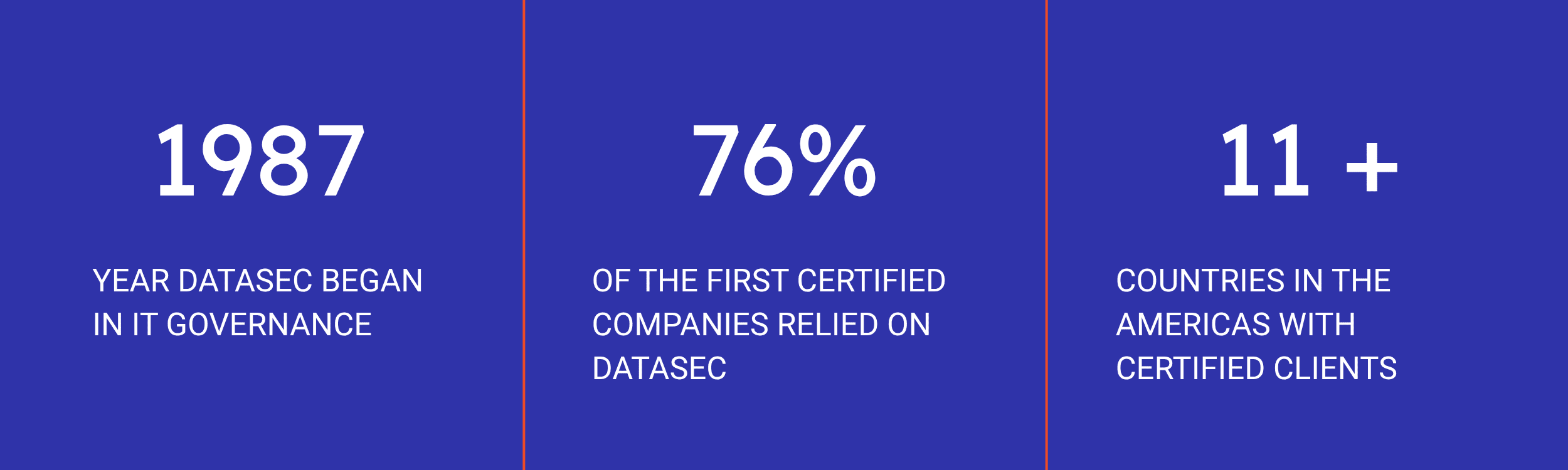
At Datasec, we are here to support you.
Contact us: contacto@datasec-soft.com